Can you keep a secret?

How Does information become something ... else?

Part 1: Why Encode Information?

Wr wkh vwxghqw doo ri dfdghpld lv d frgh zdlwlqj wr eh fudfnhg.

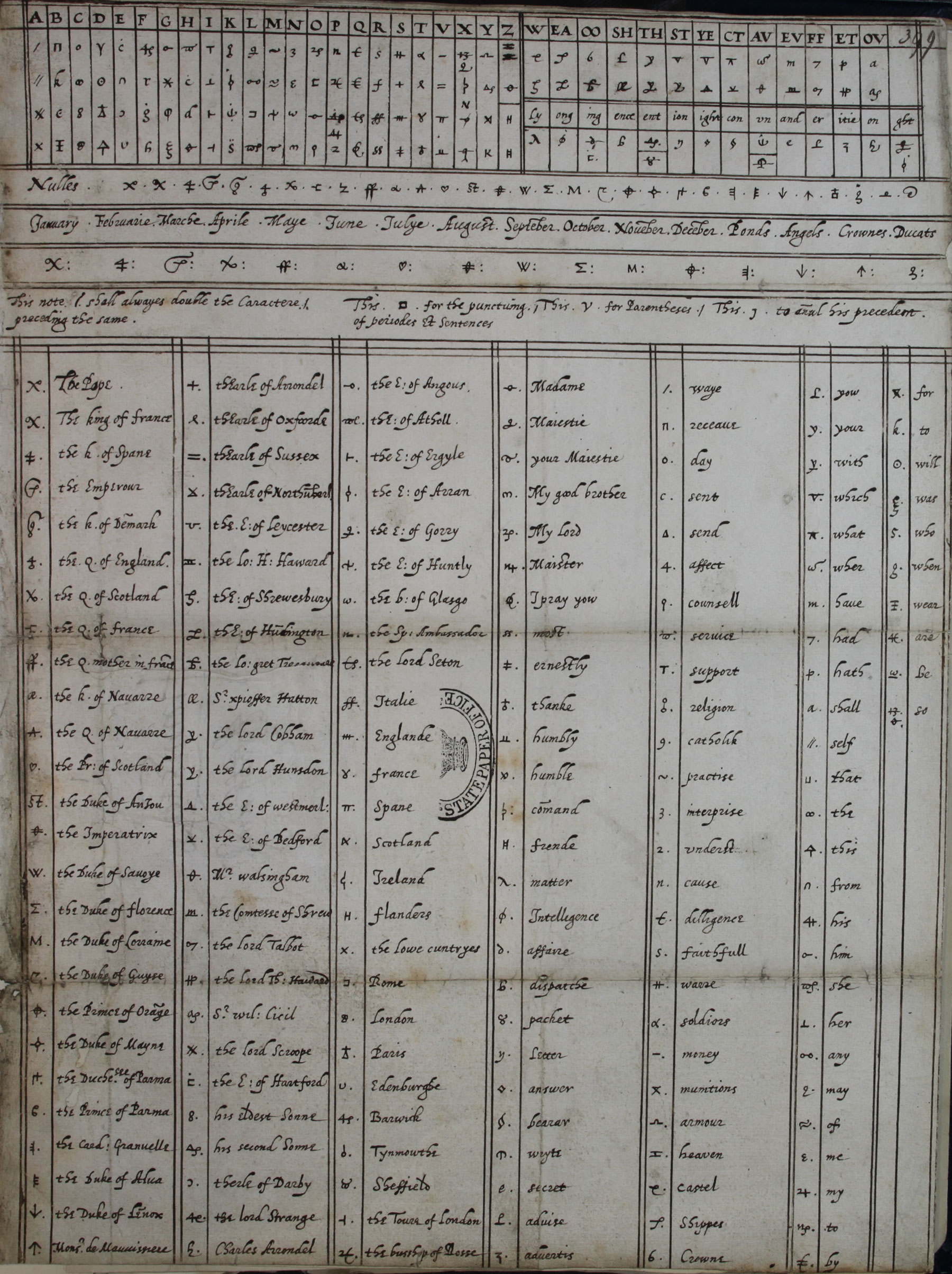
The multiple human needs and desires that demand privacy among two or more people in the midst of social life must inevitably lead to cryptology wherever men thrive and wherever they write. Cultural diffusion seems a less likely explanation for its occurrence in so many areas, many of them distant and isolated" (David Kahn The Codebreakers: The Story of Secret Writing 1967, p. 84).

Benjamin Church

First Surgeon General of what becomes the US

American, Harvard & London trained

Big wheel in Boston society

London, 1772.

I have been asked by my superiors to give a brief demonstration of the surprising effectiveness of even the simplest techniques of the new-fangled Social Networke Analysis in the pursuit of those who would seek to undermine the liberty enjoyed by His Majesty's subjects. This is in connection with the discussion of the role of "metadata" in certain recent events and the assurances of various respectable parties that the government was merely "sifting through this so-called metadata" and that the "information acquired does not include the content of any communications". I will show how we can use this "metadata" to find key persons involved in terrorist groups operating within the Colonies at the present time. I shall also endeavour to show how these methods work in what might be called a relational manner.

                           StAndrewsLodge LoyalNine NorthCaucus LongRoomClub TeaParty Bostoncommittee LondonEnemies 
Adams.John                      0         0           1            1        0               0             0
Adams.Samuel                    0         0           1            1        0               1             1
Allen.Dr                        0         0           1            0        0               0             0
Appleton.Nathaniel              0         0           1            0        0               1             0
Ash.Gilbert                     1         0           0            0        0               0             0
Austin.Benjamin                 0         0           0            0        0               0             1
Austin.Samuel                   0         0           0            0        0               0             1
Avery.John                      0         1           0            0        0               0             1
Baldwin.Cyrus                   0         0           0            0        0               0             1
Ballard.John                    0         0           1            0        0               0             0

Shannon showed us how to split "Information" and "Content" apart, which enables modern digital communications

Using metadata to find Paul Revere shows us that we don't even need to know the content of a message to decipher something of its importance

'Coding' depends on context and the broader assemblage of elements

Codes versus Ciphers, handy definitions

a code: 'variable sized elements that have meaning in the plaintext language' - syllables, words, phrases (Dooley, 5); thousands of substitutions

a cipher: a transformation from plaintext according to some transformation (Dooley, 5-6); 'small fixed number of substitution elements'

Dooley, John F. History of Cryptography and Cryptanalysis: Codes, Ciphers, and Their Algorithms. Springer International Publishing AG, 2018. via our library

Part 2: Ancient and Medieval Systems

Polybius book 10 (P lived ca 200 - ca 118 BC)

YHQL YLGL YLFL

One way to solve an encrypted message, if we know its language, is to find a different plaintext of the same language long enough to fill one sheet or so, and then we count the occurrences of each letter.

We call the most frequently occurring letter the "first", the next most occurring letter the "second", the following most occurring letter the "third", and so on, until we account for all the different letters in the plaintext sample.

Then we look at the cipher text we want to solve and we also classify its symbols. We find the most occurring symbol and change it to the form of the "first" letter of the plaintext sample, the next most common symbol is changed to the form of the "second" letter, and the following most common symbol is changed to the form of the "third" letter, and so on, until we account for all symbols of the cryptogram we want to solve.

Part 3: Early Modern Cryptography

Early Modern Europe (16th to about 1800 ish)

##

Francis Bacon & the Bi-Literal Cipher

the sort of thing that also gives rise to conspiracy theories

Now is the winter of our discontent

The One-Time Pad

similar to Vignette, but:

key has to be as long as the message
key has to be absolutely mathematically random
you can never reuse the key in whole or in part
the key has to be kept completely secret

Let's say you have a keypad, and on today's page the key is XMCKL. This is the only time you use this page; destroy after use!

letters are associated with their number position in the alphabet. Add your message to the key. If the value is greater than 26, use the remainder value

      h       e       l       l       o  message
   7 (h)   4 (e)  11 (l)  11 (l)  14 (o) message
+ 23 (X)  12 (M)   2 (C)  10 (K)  11 (L) key
= 30      16      13      21      25     message + key
=  4 (E)  16 (Q)  13 (N)  21 (V)  25 (Z) (message + key) mod 26
      E       Q       N       V       Z  → ciphertext

You've received a secret message! Find today's page & key, and subtract

(If a number is negative, add 26 to make positive)

       E       Q       N       V       Z  ciphertext
    4 (E)  16 (Q)  13 (N)  21 (V)  25 (Z) ciphertext
−  23 (X)  12 (M)   2 (C)  10 (K)  11 (L) key
= −19       4      11      11      14     ciphertext – key
=   7 (h)   4 (e)  11 (l)  11 (l)  14 (o) ciphertext – key (mod 26)
       h       e       l       l       o  → message

Part 4: The Problem of Distance

Ok, what about the media for all these codes?

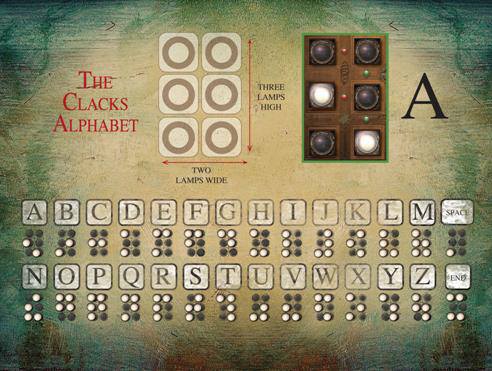
The Clacks & Terry Pratchett

Living in the Overhead

With a visual semaphore, the medium is light. With a wired telegraph, the medium is electricity.

Part 5: Discovering Electricity

Hey, what were the ancient greeks up to?

ἤλεκτρον (elektron), 'amber'

What the hell is this stuff?

Can we store this stuff?

Hey, how fast/far does this stuff go?

or, the fun you can have with 200 monks & 1 mile's worth of metal rods

you'd think there'd be a good illustration, but there isn't, so this'll have to do

Part 6: Inventing the Telegraph

'Oh, what if we have two trains on the line at once?'

1838 Edward Davy

1838 William Cooke and Charles Wheatstone

So very steampunk

Part 7: Morse and the Code

-- --- .-. ... . / .- -. -.. / - .... . / ..-. .. .-. ... - / .. -. - . .-. . -. -